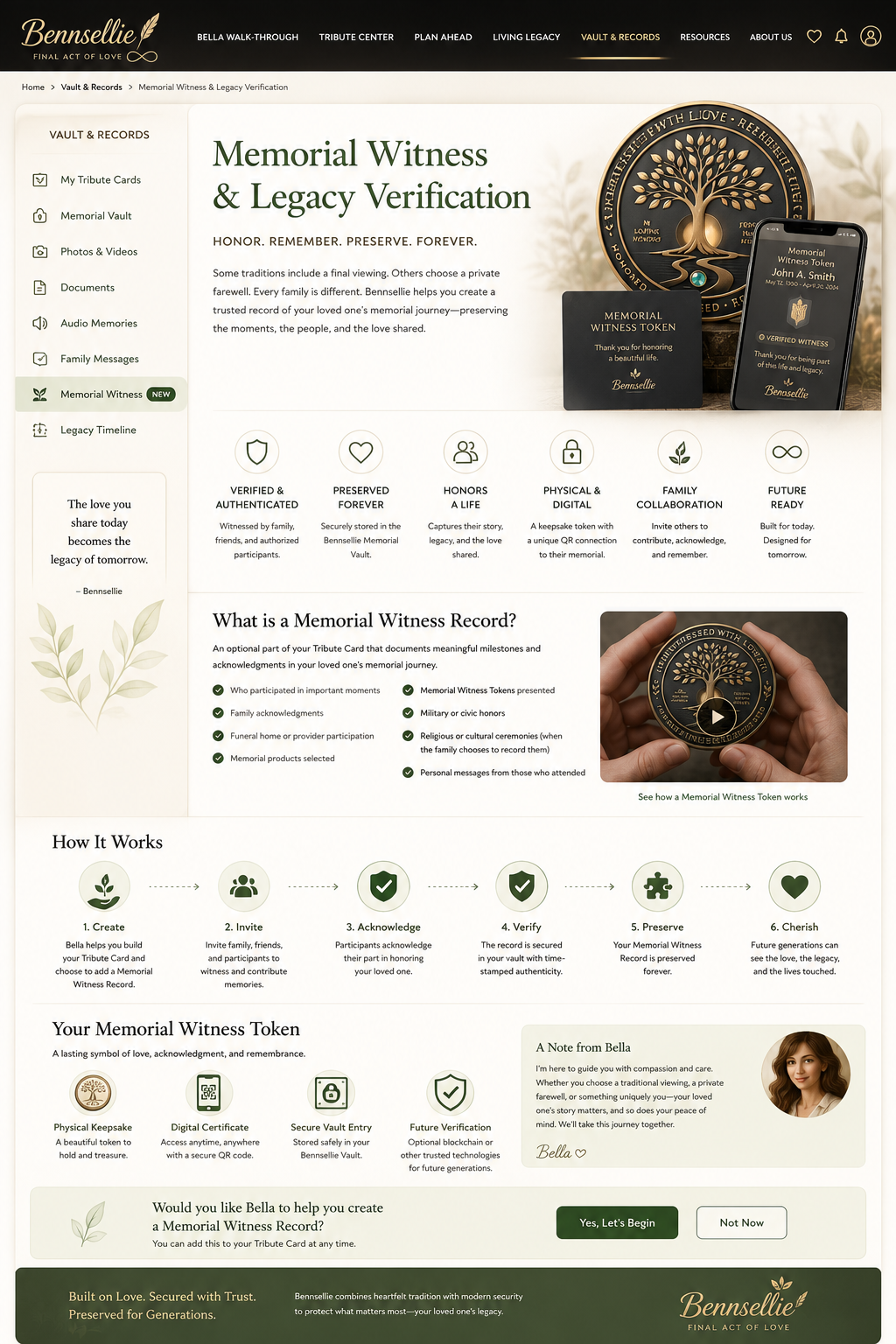
Memorial Witness & Legacy Verification
A trusted record of how a life was honored.
For families who choose not to view the body—or when viewing is not possible—the Memorial Witness Record creates another meaningful focal point: a permission-based account of the people, traditions, acknowledgments, and verified milestones that formed the farewell.
The idea
Remembering without requiring a viewing
A viewing can serve many purposes: recognition, witness, respect, tradition, public acknowledgment, and the reality of saying goodbye. Bennsellie does not claim to replace those meanings. It offers families another way to preserve them when a viewing is declined, private, limited, or unavailable.
What may be preserved
- Family and community acknowledgment
- Religious, cultural, military, civic, or personal traditions
- Authorized participants and providers
- Messages, photographs, audio, and video
- Important decisions, approvals, dates, and milestones
- The creation and presentation of a Memorial Witness Token
What it is not
It is not a declaration that a digital system has fulfilled every legal or religious requirement. It does not replace clergy, family authority, funeral professionals, or the physical care of the deceased.
It is an optional, transparent way to document the memorial practices the family selected and the people who were authorized to participate.
Family control remains central. The family chooses what is recorded, who can contribute, who may approve it, whether it remains private, and whether any physical token is created.
How it works
From family choice to lasting preservation
Bella builds the Memorial Witness section inside the same continuing Tribute Card used throughout planning, memorial creation, production, and the Legacy Vault.
1
Bella asks
Will there be a viewing? What traditions or acts of acknowledgment matter to the family?
2
The family chooses
Select a private or public witness process, invited participants, privacy settings, and any ceremonial focal point.
3
Participants contribute
Authorized family, clergy, providers, celebrants, or representatives add or verify selected information.
4
The record is confirmed
Approvals, dates, contributions, and any supporting media are preserved with an audit history.
5
The legacy continues
The approved Memorial Witness Record and optional token remain connected to the Tribute Card and Legacy Vault.
Physical + digital continuity
The Memorial Witness Token
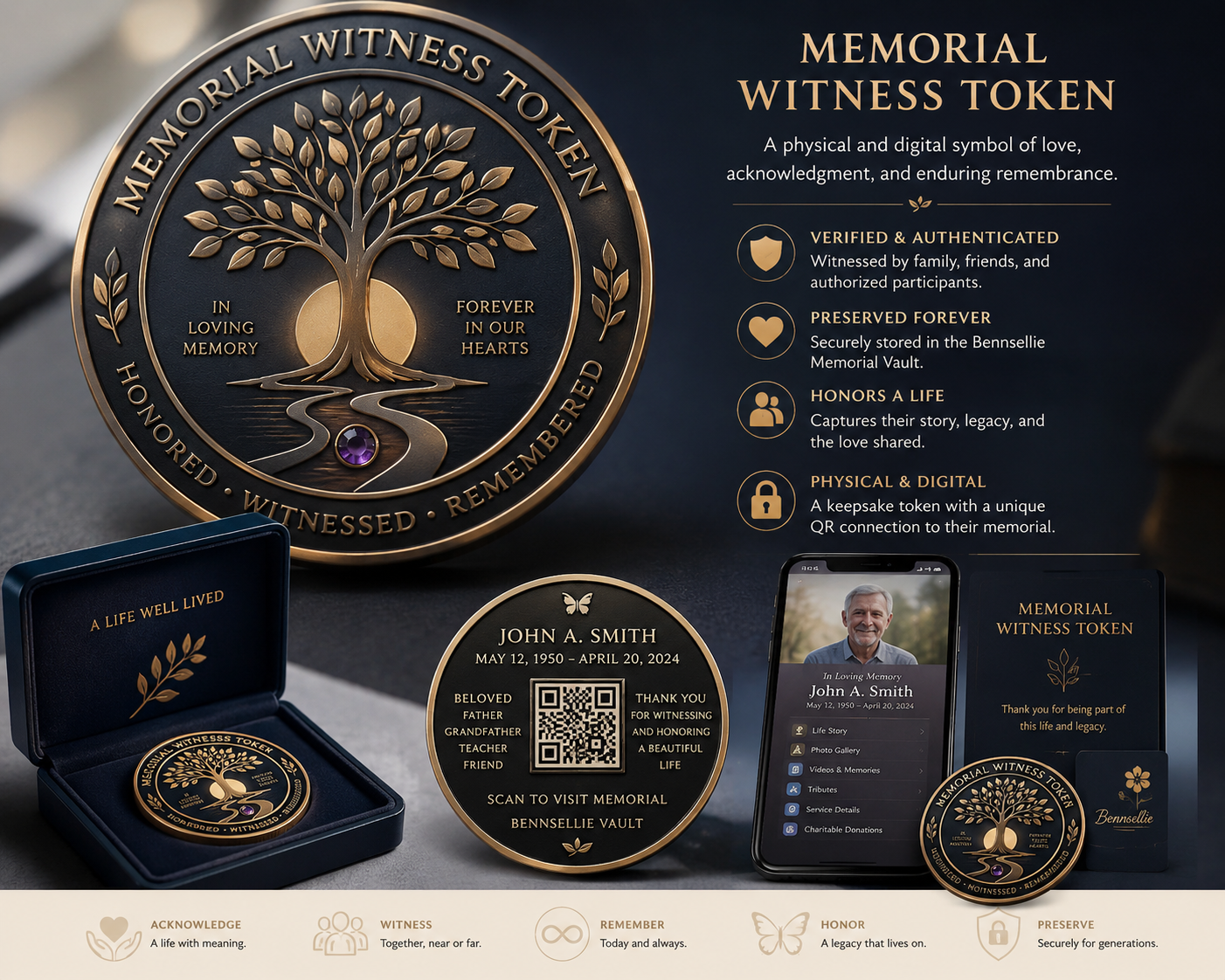
The token is an optional symbol that a life was witnessed, honored, and remembered. It may be presented to a family, placed with a memorial product, or linked to selected portions of the Legacy Vault.
✓Physical formEngraved medallion, certificate, plaque, insert, panel, keepsake, or another family-approved object.
✓Digital connectionA secure code or identifier can connect the token to the authorized Memorial Witness Record.
✓Presented, not merely scannedThe token can become part of a ceremony or family presentation rather than only a technical link.
Transparent collaboration
Trust without making technology the center
The important part is not whether the system uses a particular technology. The important part is that the record can show who was authorized, what was contributed, what was approved, and how the memorial process unfolded.
Role-based authority
Different permissions may be assigned to family members, clergy, funeral professionals, veterans’ representatives, celebrants, or other approved participants.
Time-stamped history
Contributions, approvals, changes, and completed milestones can be preserved in a transparent history within the Tribute Card.
Future verification options
Secure signatures, tamper-evident ledgers, distributed verification, or future technologies may be used without defining the meaning of the memorial itself.

“Would you like me to help preserve not only the memorial, but also the story of how this life was honored?”
Respecting beliefs and traditions: Bennsellie may help record preferences, contact appropriate representatives, document selected acts, and preserve family-approved information. It does not determine whether any act satisfies a legal, cultural, or religious requirement.